This year, we enjoyed having 25 young people staying in the hostel as part of Young Birders' Week 2023. The event was generously funded by Pembrokeshire Bird Group and the Nature Networks Fund which helped to make the event accessible for young people.
We got up to a variety of activities during their stay - from moth trapping to cetacean watching, Manxie chick weighing and quizzes it truly was a fun week for the island staff. But that's enough from me - let's give our young people a voice and hear their thoughts on the event.
Rob, Skomer VO
------
1. Liliana
 |
| Liliana holding a Manxie chick |
A treasure trove of tremendous wildlife, a windswept
landscape bejewelled with birds, which holds such a special place in my heart.
Skomer Island, a place I have been lucky enough to visit on a few occasions
over the years as a Pembrokeshire local myself. After staying on the island for
weekly volunteering in April I couldn’t wait to get back and this years Young
Birders week was the perfect opportunity. Seeing the island in September is
quite a different experience to the chaos of the breeding season, but no less
spectacular. Autumn migrants are starting to pass through, the weather is even
more
changeable, and the Manx Shearwater chicks are beginning their nightly
preparations for their extraordinary fledging to Argentina.
Having just finished my second year of Zoology at Cardiff
University, Skomer Young Birders presented a fantastic opportunity to get some
first-hand survey experience and develop my passion for birds around
like-minded young people. I attended the week last year too and feel as though
it really helped propel me further in my personal and academic life, giving me
a taste of what working outdoors in field research might be like and vastly
improving my identification skills. So I was back again this year, eager to
learn more from the staff, researchers, and other young birders.
We had the chance to conduct cetacean surveys with the Long
Term Volunteers, spotting pods of porpoise fishing around Garlan Stone, and hear
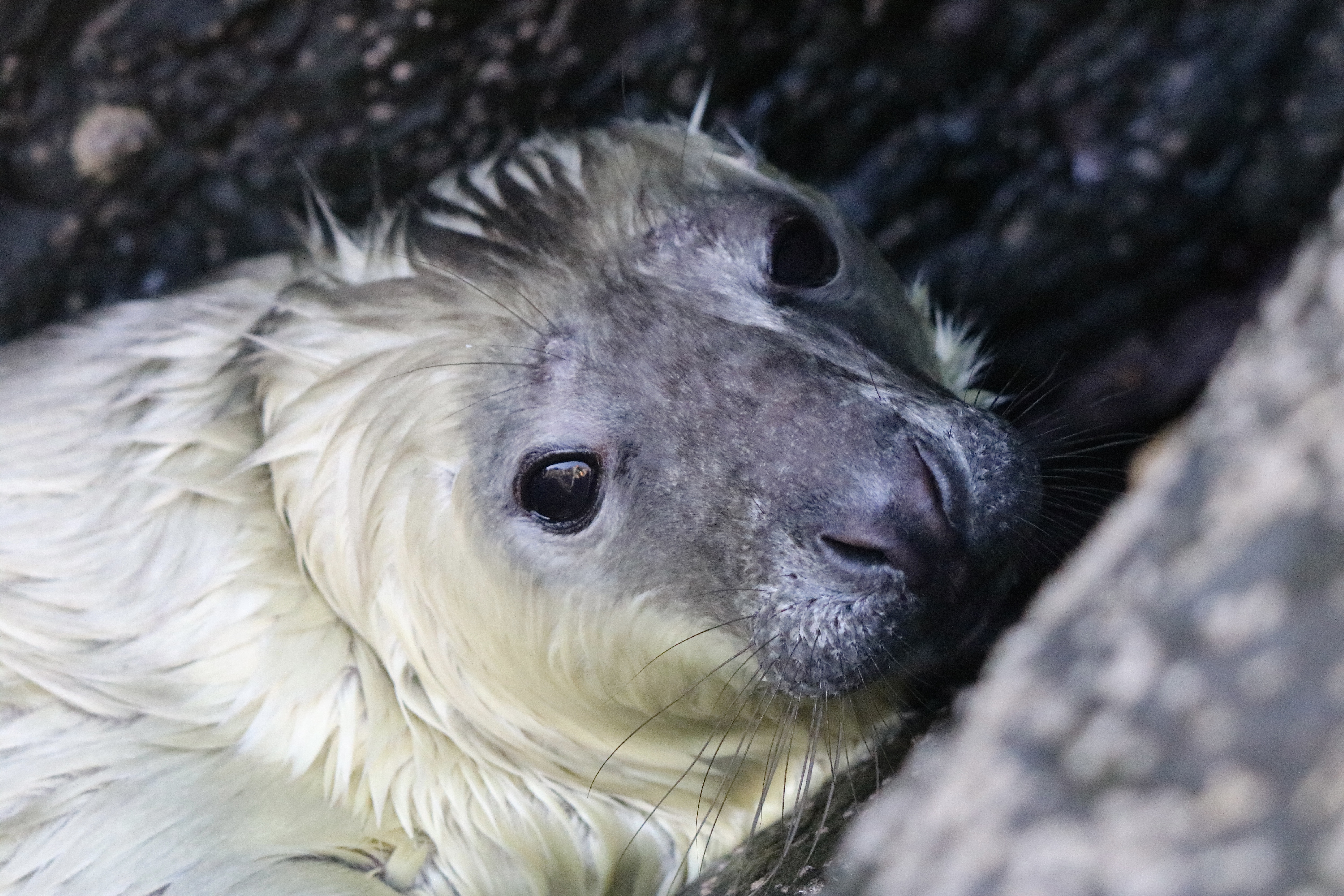
from the resident grey seal researcher who told us all about the lives of seals
while we watched newborn pups take their first swim. One evening we set up Skomer
vole traps, filling them with cozy straw bedding and lots of oat snacks, then
checked them the following morning. Getting to hold the little voles was
wonderful, they have such sweet little faces, and learning that they are
recognised as a genetic sub-species was fascinating for the evolutionary
biologist in me. Helping out with the daily Manxy chick weighing was a definite
highlight. The chicks were all in various stages of loosing their fluffy down
which was resulting in some extremely funky feather-styles, somehow making them
even cuter! I will also never forget the moth trap that we did on the second
night, I have never seen so many moths in my life! There must have been almost
300 moths, which gave everyone plenty of time to improve their ID skills as we
sorted through all the species.
The weather was unseasonably warm so daily swims were a
must, and the birds passing through over the few days were marvellous. My first
ever Hoopoe, Wryneck and Spotted flycatcher all on the same day! However, when
the final day came, and the annual bird race was upon us, the sea mist had well
and truly set in. It definitely made the race far more interesting, not being
able to see the sea from the cliffs rather ruled out spotting any seabirds and
did force everyone to rely more on sound ID, an area in which I still have a
lot to learn. I really enjoyed getting to know the other young people over the
few days and the range of interests, backgrounds and birding-skill meant
everyone had something to learn from each other.
I cannot sing the praises of Skomer Young Birders enough, I absolutely
love nature, the outdoors, and birds, and I thoroughly enjoyed the whole
experience! Everyone was so friendly and willing to share their knowledge and
the organised activities provided great practical experience, while the free
time left plenty of opportunity to explore this special island. A fantastic few
days in a beautiful place with great people creating memories I will treasure…
what more could you ask for.
------
2. Ellie
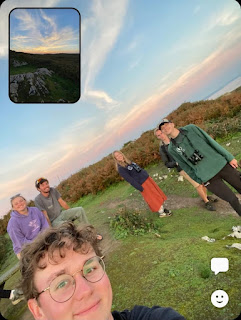 |
| Ellie, as seen in Jake's selfie of their team on the Bird Race |
Having now had the chance to look through my camera at the
hundreds of photos I took that week, I can officially say I ticked off 52
species, and 6 lifers in 4 days! While seeing the birds on a young birders trip
was key, the people and the landscape really boosted how great this trip is to
look back at. We've all kept in contact back on the mainland and are already
looking for ways to get back. The staff are so enthusiastic about what they do
and what they know, super inspiring. As someone aiming for this line of work it
was such a good insight into fieldwork based ecological employment. Such a wel
organised trip, ace activities and as much fun and laughs as their was wildlife
on the island. Can't recommend this week enough no matter the level of birder you
enter at, guaranteed to learn something new and look back fondly.
------
3. Jenny
 |
| Jenny holding a Skomer Vole |
Up goes the ferry, down cries my belly, we’re coming round
the bend, here it goes! No mysterious out-of-mist reveal but in its place a rare
sighting: the sun! and with it an infrequent glow, the island in the distance
standing proud like a crow. “There!” shout the crew of the Dale Princess,
pointing to the rising fin popping out of the sea as its owner sinks back in.
We rise and rush to one side of the boat, catching sight of a rogue juvenile
razorbill afloat.
When we make it to shore, the recently crowned islanders are
weaving up the stairs, ready to start heaving as they lift our bags in conveyor
belt formation and their faces are alit with the kind of joy reserved for i-went-on-a-yoga-retreat-but-then-i-ended-up-enlightened-to-the-fact-that-pied-wagtails-are-massively-underrated.
Once we arrive there is a man with blue hair standing on a dumper and a tall
lady with short hair almost, well yes actually, jumping up and down and both
are grinning and we’re spinning our bags onto the four-wheeled yellow vehicle.
They’re telling us that this is their favourite week and we’re wondering if
they say this every week but really they do seem very excited and we’re excited
and we all plod up the path.
There is the farm and the swallows are singing, Mario karting
around the archways of the old barn with no roof. The sun is high and we can
spot a few others (meadow pipit, singing robin, is that a linnet? Oh I don’t
know) coming to join the party. After we get a low-down of the plan we make a beeline
for the path, as the grinning blue haired man (Rob is his name) is giving us a
tour of the island. We begin east side I think but it could be south, because
at this point we’ve got first-time-round jelly brains which makes us see
through frames that make island orientation utterly different from all the
times that will follow.
Rob’s leaping from path to rock, pointing high and low and
jumping to and fro explaining all the essentials he thinks we need to know. The
puffins and razorbills and guillemots were here, but now they’re not just the
shearwaters that walk weird. But here, eat this leaf it tastes like lemon and
called sorrel and this other one tormentil is a yellow four petalled flower.
You see the different gulls? The herring and greater and lesser black backs and
maybe we’ll see some kittiwakes and oh whats that sound? The chough’ty chough
choughs! Jibbering away yes jabber chatter blabber. Is that a pheasant?? What’s
hopping? I hear a hollow whaling sound! Red admiral, hello!
The visitors have gone round the bend we’ll sing a fair well
song and then splash! Wasn’t me, oop hello there you are a curious whiskered
watery mammal! Stop hiding underwater please!
Next day, we’re out
near the Neck, burrows blobbing the landscape, Sarah reaches down, until she’s
armpit level with the ground. Then a fluffy one’s in her hand, blinking and
wondering why he’s back on the scales. But she’s measuring your weight before
fledge, it’s important stuff you know and now you’ve all got special burrow
numbers, a bit random but its your very own code! Alright he thinks and settles
in, adorning his fluff to the goggle-y eyed strangers, although he’s a rare
one, his friends mostly preferring the squiggle, squirm, flap technique. Sarah
shows her expert shuffle, lightly tip tapping across the land, stepping on just
the right mound as to keep everything bound.
Their nocturnal habits were quite the intrigue, and we came
back to see what all the legendary partying around at night was about. Indeed,
we discovered they even keep the bouncy castle tradition alive, and with a big
moon in sight some say no not tonight. But others were ready, had the
Argentinian tango in mind, and off they went on their 11-day flight.
The days continued on…a snoot, the unseen coot, only choice was
the route. The mysterious incident of two voles trapped at nighttime. Whaling,
bathing seals on the shore, what more? Sunnies, full tummies and bunnies
galore. All played a part in making this a curious week: the bee and bird buffs,
the flying rocket enthusiasts, the master devil’s coach horse spotter…the convolvulus
hawk moth! There was excitement, and movement and squawking all around - and
not just from the birds. A fantastic time. Thank you to the amazing team on
Skomer Island!
------
4. Daisy
 |
| The group on a guided walk of the island with VO Rob |
In the first week of September this year, I was lucky enough
to take part in Skomer’s Young Birders’ Week. This is a yearly opportunity for
people aged 18-25 to experience a 3-night stay on the island and see all it has
to offer in the autumn, including Manx shearwater chicks, new-born seal pups
and migrating birds on their way to their winter grounds.
I found out about the week on social media and thought it
sounded like the perfect chance to get back to nature. I’ve loved wildlife for
almost as long as I can remember, and volunteered with a few different
organisations to this end, including monitoring marine mammals with the
Wildlife Trust at Cardigan Bay. I studied Biology at university, hoping to one
day work in conservation. Since graduating, I’ve worked in an office job for an
environmental charity, but have really missed the outdoors and the connection
to nature that more hands-on conservation can bring.
I travelled from Bedfordshire to west Wales via three trains
and a friend’s van, arriving at the boat to Skomer for 10am. The wildlife lost
no time and as we reached the docking area on the island we saw three porpoises
surfacing, including a calf, just a few metres from the boat. Gannets and
fulmars were gliding above the sea and the skies were blue and sunny – and stayed
that way until we left – something I’m not used to on the Welsh coast!
The next 3 days were packed full of experiences that were
just as magical, including weighing Manx shearwater chicks, night walks around
the island, and vole trapping, meaning we could see and handle the endemic
Skomer vole, a subspecies of bank vole. The team on the island were extremely
generous with their time, letting us help set up traps, and answering any
questions we had about the island and their work on it.
Although it’s hard to narrow it down, my highlights of the
week were:
·
Morning moth trapping – there were some
beautiful moths that I’ve never seen before, including a huge
Convolvulus hawk-moth.
·
Watching a short-eared owl hunt over the bracken
as the sun was setting on our first night on the island.
·
Night walks, seeing some of the hundreds of
thousands of Manx shearwaters on the island take their first flights and start
their migration to Argentina (including one which fledged from the rock Sir
David Attenborough sat next to on his recent documentary, Wild Isles)
·
Sitting at the farmhouse, where the visitor
accommodation is, watching swallows swoop around the old buildings while having
breakfast.
·
Walking around the whole island as part of a
Bird Race on our last day, where we split into teams and tried to see as many
species as possible. Despite the competitive aspect, when one team spotted a little
owl sitting in a rock formation they immediately sent detailed directions to
the whatsapp group so that everyone would have a chance to see it. We also saw
a peregrine falcon, a spotted flycatcher, some of the island’s choughs, a pair
of curlews, and then later on a snipe and dunlin resting at the North pond.
A huge thank you to the staff, volunteers and researchers on
Skomer as well as the other young birders for all they did in making it such a
wonderful few days. And another thank you to the Wildlife Trust of South and
West Wales for making the week possible. It’s really inspired me to spend some
more time out in nature, birdwatching and volunteering – and I’m already
looking into applying to come back to Skomer to volunteer. It’s a difficult
place to leave behind!
 |
| The first group |
 |
| Our second bunch of young birders |